
A Composite Awning Guide: Applications, Benefits and Installation Considerations
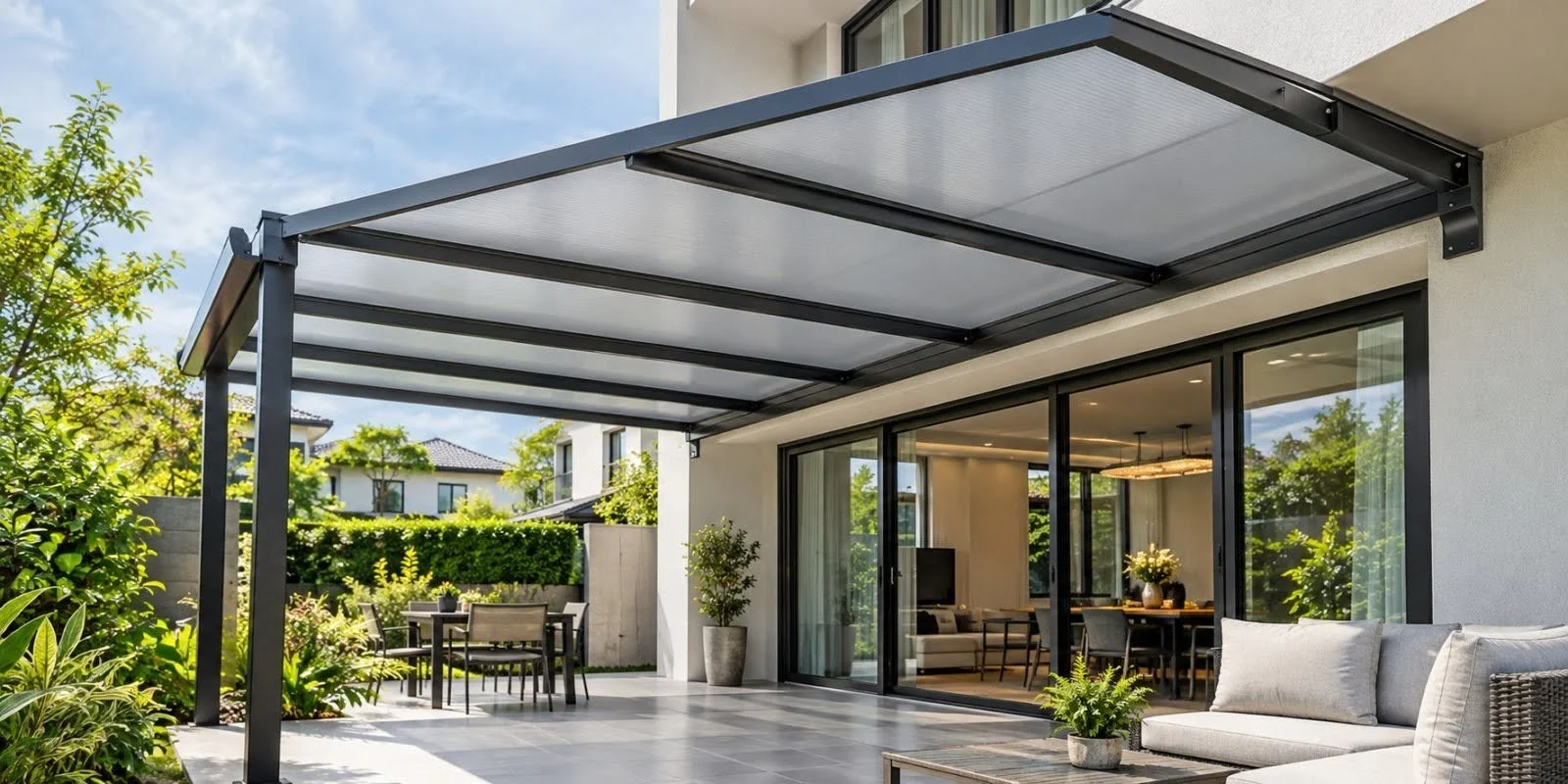
A composite awning is a fixed outdoor shelter that uses composite panels as its overhead covering. For property owners considering a composite awning in Singapore, the main question is not simply what the panel is made from, but whether solid permanent coverage is appropriate for the location and how the awning will interact with the property.
Composite awnings can be considered for selected residential and commercial applications where a fixed, opaque shelter is preferred. Their suitability depends on the area being covered, architectural requirements, site dimensions, supporting arrangement and how the outdoor space is expected to function.
Rather than concentrating heavily on material composition, this guide focuses on where composite awnings make sense, what practical benefits they can provide and what property owners should consider before installation.
A Composite Awning Provides Permanent Opaque Coverage
A composite awning creates a fixed overhead surface that remains in position rather than opening or retracting. This makes it suitable for areas where continuous coverage is part of the property requirement.
The opaque surface distinguishes it from transparent or translucent shelter options. Daylight does not pass directly through the panel in the same way it can through certain other awning coverings.
This can be useful where property owners specifically want solid overhead coverage.
The decision should therefore begin with whether the outdoor area benefits from permanent opaque shelter rather than whether composite panels are available.
Composite Awnings Work Best Where Fixed Shelter Is Intentional
A fixed awning is most appropriate where the property owner expects the area to remain covered during normal use.
An entrance that regularly needs overhead shelter is one example. Other exterior areas may also benefit from permanent coverage depending on their purpose and layout.
A composite awning is less appropriate where occupants regularly want to alternate between covered and completely open conditions. A retractable system may be more relevant in that situation.
Understanding this distinction helps determine whether a composite awning should remain under consideration before detailed design begins.
Residential Applications Should Begin with the Outdoor Space
Residential properties can use composite awnings in selected exterior areas where fixed coverage is required. The application should be determined by how the property is arranged and how occupants use the space.
An awning can potentially be incorporated around an entrance or another outdoor area where permanent shelter supports everyday use.
The required dimensions should relate to the actual area rather than extending coverage simply because more space is available.
Doors, windows and existing rooflines can influence the final configuration. The awning should therefore be designed as part of the property rather than treated as a separate structure added without reference to its surroundings.
Entrance Areas Can Benefit from Consistent Shelter
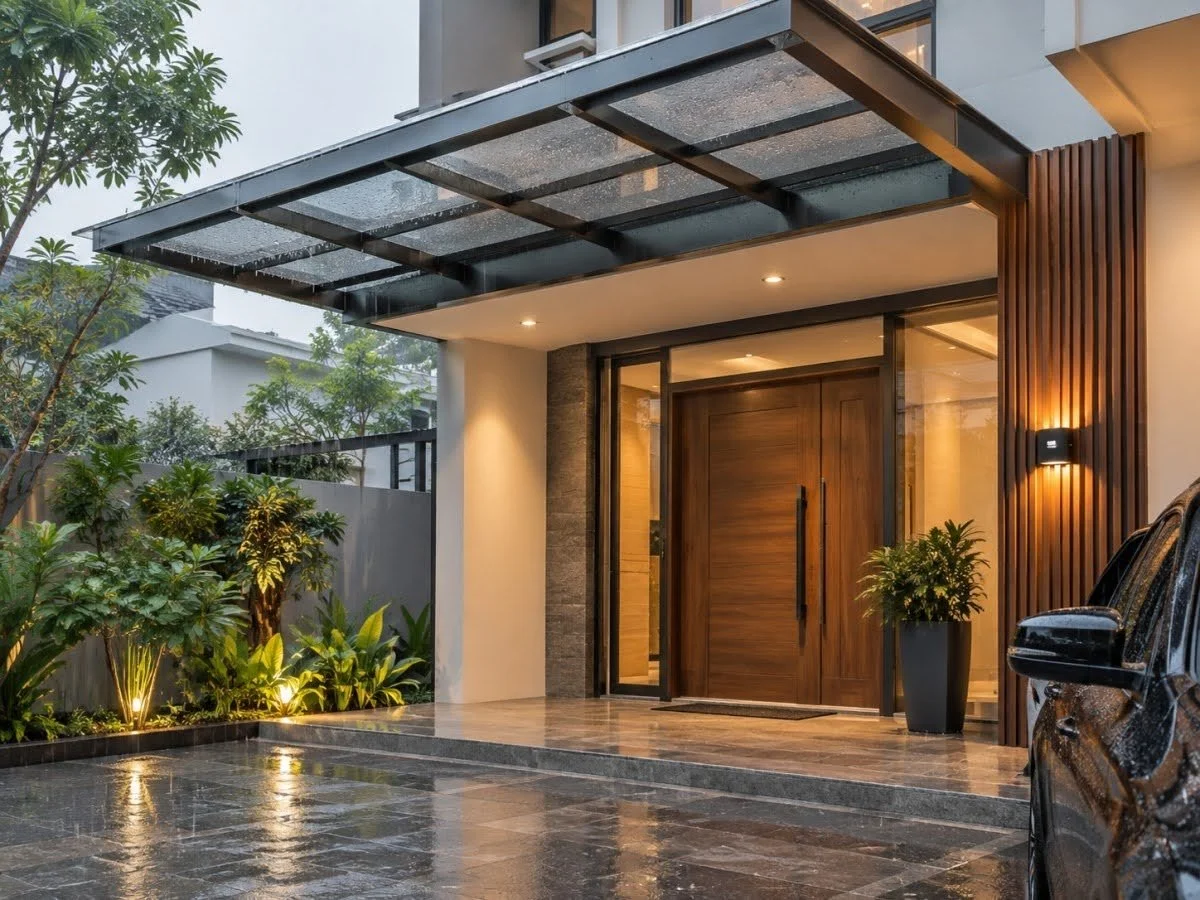
An entrance is one application where permanent overhead coverage can be practical. People regularly pass between indoor and outdoor environments, making consistent shelter useful regardless of whether the area is actively occupied.
The awning should cover the intended transition zone rather than only respond to the dimensions of the doorway.
At the same time, the design should consider surrounding features such as windows, lighting and the overall façade.
A well-planned entrance awning should perform its shelter function while remaining proportionate to the area it serves.
Commercial Applications Require Operational Planning
Commercial properties may use fixed awnings where permanent shelter supports regular activities around the building.
The planning process should consider how customers, employees or visitors move through the area. An awning should not introduce unnecessary obstacles or interfere with important access points.
Commercial façades may also contain signage, lighting and other building features that influence the available installation space.
The required coverage should therefore be established according to both physical dimensions and daily property use.
Composite Awnings Can Support Contemporary Architectural Design
Composite panels can create a relatively clean and defined overhead surface, making them relevant to properties where the awning is intended to form part of the architectural appearance.
The awning can be coordinated with existing façade lines, exterior finishes and other visible property features.
Proportion is important. A shelter that is much larger than surrounding architectural elements can dominate the façade, while one that is too small may not provide meaningful coverage.
The objective should be to integrate the awning with the building while preserving its practical role as outdoor shelter.
Opaque Shelter Changes the Lighting Beneath the Awning
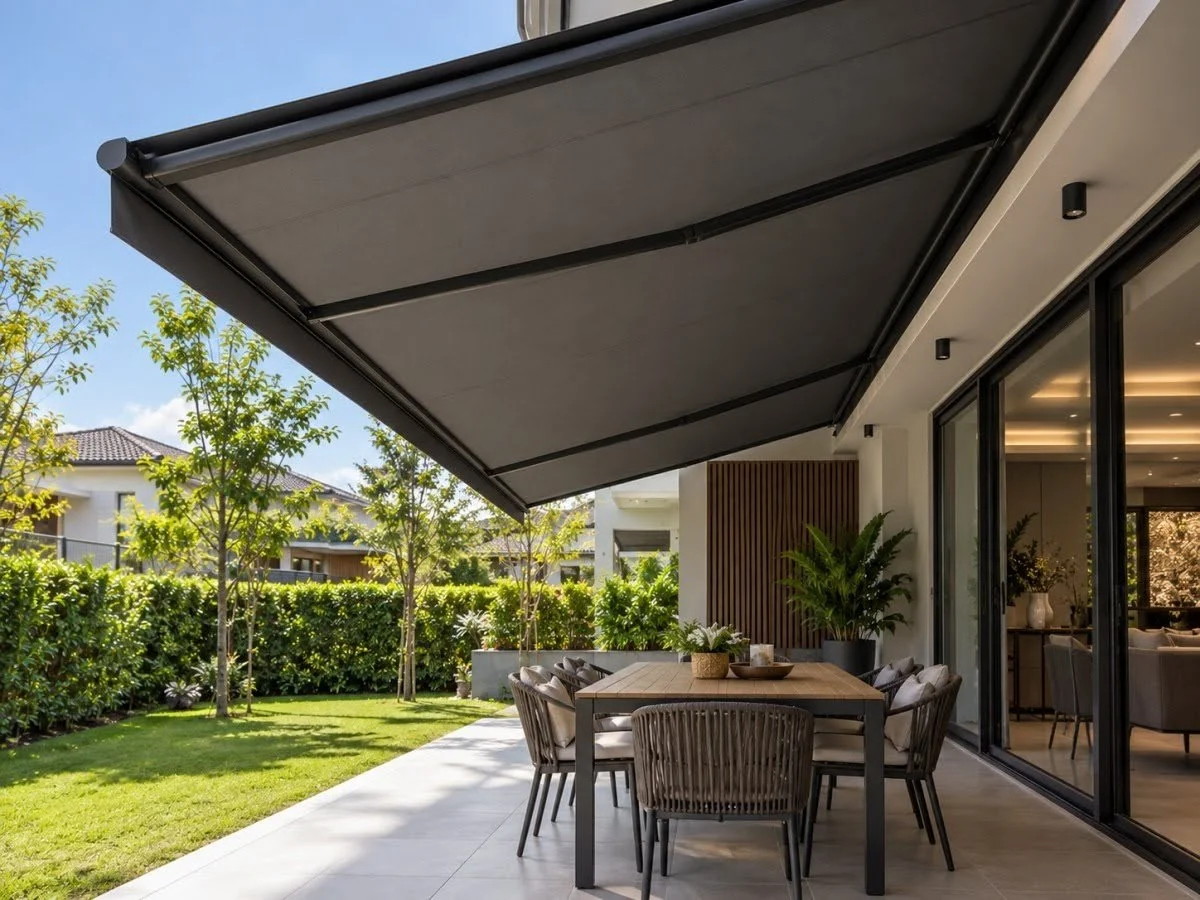
A composite awning blocks direct overhead daylight through the covered surface. This creates different conditions from a translucent polycarbonate canopy or an area without overhead shelter.
For some applications, this is desirable because consistent shade is part of the requirement. In others, maintaining more natural light beneath the shelter may be important.
Property owners should consider how the space currently receives daylight and how permanent opaque coverage could change it.
The effect can also extend to nearby doors and windows if the awning projects close to them.
The Position of Nearby Windows Should Be Considered
Windows close to an awning can influence both the design and the experience of the indoor space.
A fixed opaque shelter may affect how daylight reaches nearby windows depending on its dimensions and position.
Window opening should also be considered where relevant. The proposed awning should not unnecessarily interfere with normal use of the property.
Reviewing the façade as a whole is therefore more useful than assessing only the empty space where the awning is expected to be installed.
Composite Awnings Have Practical Advantages for the Right Application
The main benefits of a composite awning relate to the type of shelter it creates rather than broad claims about the material.
For an appropriate application, advantages can include:
Permanent overhead coverage
An opaque shelter surface
A defined architectural appearance
Customisation according to property dimensions
Suitability for selected residential and commercial applications
These characteristics can make composite awnings relevant where property owners already know they want fixed, solid coverage.
They should still be evaluated alongside the site's structural, design and usage requirements.
Permanent Coverage Can Also Be a Limitation
The same characteristic that makes a composite awning useful can be a limitation in another property. Once installed, a fixed awning does not provide the flexibility of a retractable system.
If occupants sometimes want the outdoor area completely open overhead, permanent coverage may not match that usage pattern.
Opaque panels can also alter natural lighting beneath and around the shelter.
These are not necessarily disadvantages of the product itself. They are reasons to determine whether the application is suitable before selecting the awning.
The Awning Should Be Designed Around Its Actual Projection
Projection refers to how far the awning extends outward from its mounting or supporting area. This dimension has a direct effect on the amount of coverage provided.
A greater projection does not automatically create a better awning. It needs to correspond with the intended shelter zone and property conditions.
For example, an entrance may require enough projection to create a useful covered transition area without extending unnecessarily into surrounding space.
Accurate planning should therefore establish the required coverage first and determine the dimensions from that requirement.
Singapore’s Rainfall Makes Water Direction an Important Design Issue
Any fixed awning creates a surface that collects rainfall. The design therefore needs to consider what happens to that water after it reaches the shelter.
The relevant approach depends on the awning configuration and existing property conditions.
Entrances and pedestrian areas require particular attention because poorly directed water can affect spaces people regularly use.
The purpose is not merely to move water away from the panel. It is to ensure that the completed shelter works appropriately with the surrounding property.
Site Conditions Determine How the Awning Can Be Supported
A composite awning requires an appropriate supporting arrangement based on its dimensions and installation location.
The visible panel is only one part of the completed shelter. Supporting components and mounting conditions are fundamental to the installation.
A contractor should assess the relevant property features before the final design is prepared.
Where additional structural assessment is required, it should be identified during planning rather than after customised components have already been produced.
Installation Should Follow Confirmed Measurements
Composite awnings can involve components prepared according to project-specific dimensions. Accurate measurement is therefore important before fabrication or installation begins.
The contractor should establish the required width, projection and relevant mounting information from the actual site.
Nearby doors, windows and architectural elements should also be recorded where they affect the proposed configuration.
Once the project details are confirmed, preparation can proceed using information that reflects the real property rather than approximate dimensions.
Panel Layout Can Influence the Finished Appearance
Composite awnings should be considered as complete visible surfaces rather than only as individual panels.
Depending on the size and configuration of the project, panel layout and transitions can affect the appearance of the finished shelter.
These details are particularly relevant where the awning is prominent on the property façade.
The layout should therefore be considered before installation rather than leaving visual alignment entirely to decisions made on site.
An Aluminium Composite Panel Installer Should Understand the Application
Where aluminium composite panels form part of the awning system, the installer should understand more than how to handle the panel itself.
The contractor should be able to relate the panel system to the required coverage, property dimensions and supporting arrangement.
This is particularly important for customised applications where the finished awning needs to integrate with existing architecture.
Property owners can ask how the proposed design responds to their specific property rather than focusing only on whether the installer works with aluminium composite panels.
Maintenance Planning Should Focus on Accessibility
A fixed awning remains exposed outdoors after installation, so property owners should consider whether relevant areas can be accessed for routine care and inspection.
Cleaning requirements depend on the actual panel system and finish. Product-specific instructions should be followed where available.
Debris should not be allowed to accumulate in areas where it could interfere with the normal function of the shelter or associated water management.
Visible changes around panels, connections or supporting components can also provide a reason for further assessment.
Completed Projects Can Show How Composite Awnings Are Applied
Project examples are useful because they show how a composite awning interacts with a real property.
Rather than looking only at close-up panel photographs, property owners can examine the overall dimensions, placement and relationship between the awning and surrounding façade.
Residential and commercial examples may also illustrate how different applications lead to different configurations.
Actual Moonlight Pte Ltd. project examples can provide this type of practical reference when assessing how composite awnings have been incorporated into completed properties.
Compare Composite Awnings with the Requirement, Not Every Material
Property owners do not always need a lengthy comparison between every available awning material. A more efficient approach is to compare the proposed composite awning directly with the functional requirement.
Useful questions include:
Does the area need permanent coverage?
Is opaque shelter appropriate?
Will the awning affect important nearby windows or doors?
Does the design fit the architecture?
Can the required dimensions be supported by the site?
Is the completed system reasonably accessible for care?
If the answer to an important requirement is no, another awning configuration may deserve consideration.
Frequently Asked Questions (FAQs)
What is a composite awning?
A composite awning is a fixed outdoor shelter that uses composite panels as its overhead covering. It provides an opaque surface and remains permanently positioned rather than retracting.
Where can composite awnings be used?
They can be considered for selected residential and commercial exterior areas where permanent overhead shelter is required. Suitability depends on the specific property, coverage requirement and installation conditions.
Is a composite awning suitable if I want natural light from above?
Composite panels create opaque coverage, so they do not provide the same overhead light transmission as transparent or translucent shelter options. Property owners who prioritise natural light through the covering should compare other suitable systems.
Is a composite awning better than a retractable awning?
They address different requirements. A composite awning provides fixed coverage, while a retractable awning allows the user to alternate between covered and open conditions. The appropriate choice depends on how the outdoor area is used.
What should I discuss before installing a composite awning?
Discuss the intended coverage, property dimensions, nearby doors and windows, architectural requirements and relevant site conditions. The contractor can then assess whether the proposed fixed awning suits the location.
Fixed Shelter Should Have a Clear Purpose
A composite awning is most useful when a property genuinely benefits from permanent opaque overhead coverage. Its value comes from matching that type of shelter with an appropriate entrance, outdoor area or commercial application.
Property owners should therefore begin with the function of the space and then consider dimensions, architectural integration and installation conditions.
This approach avoids selecting a composite awning simply because of its material and keeps the project focused on how the completed shelter will work as part of the property.
Explore a Composite Awning for Your Property
Property owners considering a composite awning can prepare information about the area requiring permanent shelter, approximate coverage and surrounding property features before arranging an assessment.
For project-specific guidance on composite awning applications and installation considerations, contact Moonlight Pte Ltd. to discuss the proposed property requirements.