A Polycarbonate Awning Guide for Singapore Properties
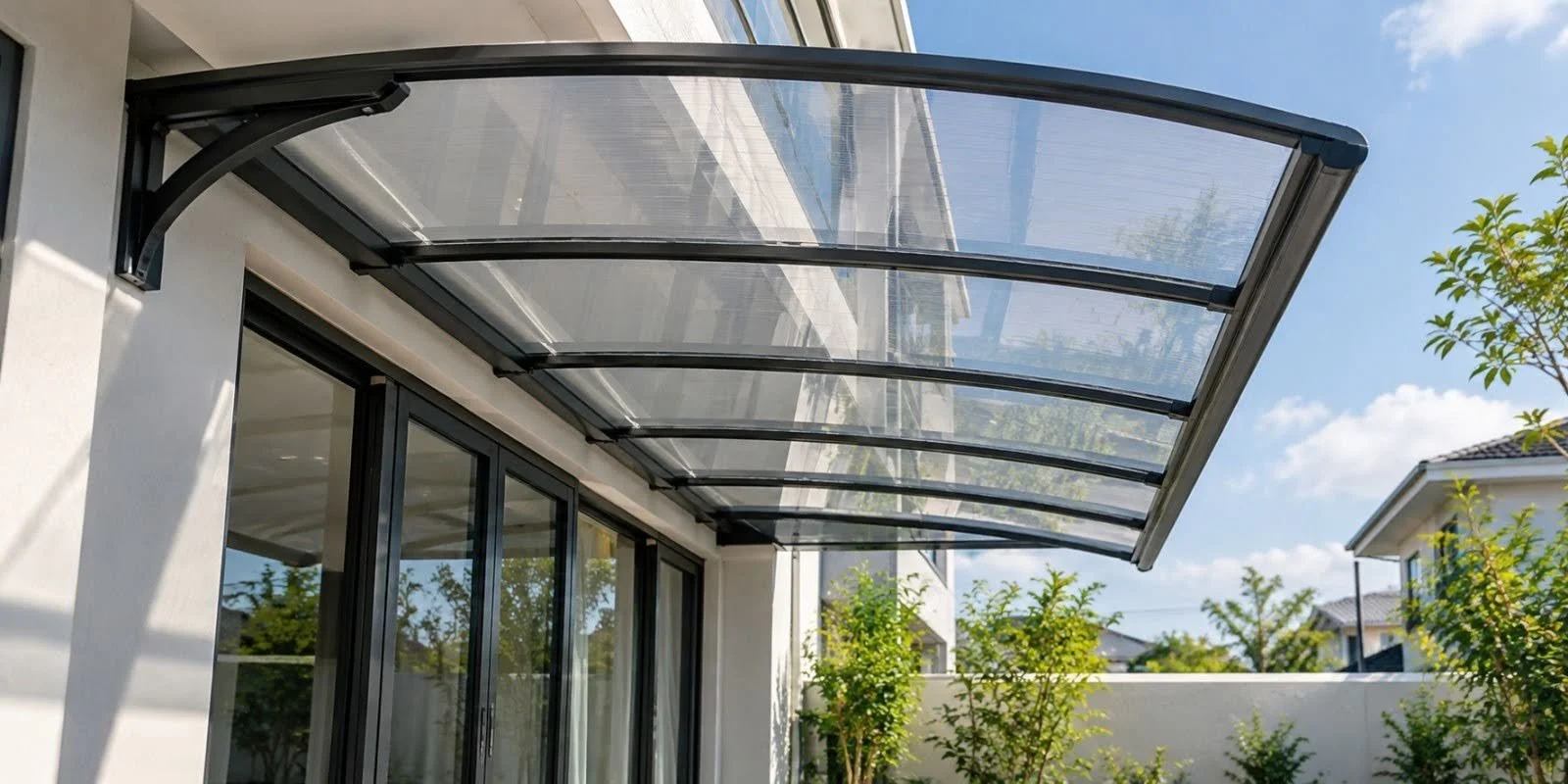
For property owners who require an overhead covering allowing a degree of natural light through the shelter, installing a polycarbonate awning in Singapore could be the ideal solution. A polycarbonate awning is a fixed shelter that uses polycarbonate sheets as the overhead covering.
This type of awning creates a different type of covered environment from an opaque awning. It can be useful where property owners want protection over an entrance, walkway, or other outdoor area without creating a completely solid overhead surface.
However, transparency or light transmission alone should not determine whether polycarbonate is appropriate. The position of the property, amount of sunlight, required rain protection, drainage arrangement, dimensions, and supporting system should all be considered before installation. Let’s explore more of these factors in depth.
The Best Application Depends on How the Space Is Used
A polycarbonate awning should be selected according to the outdoor area it serves rather than because polycarbonate is a familiar awning material.
Common applications can include entrances, walkways, and selected residential or commercial outdoor areas.
Each application creates different priorities.
An entrance may require compact coverage around a doorway. A walkway may need a longer continuous shelter. Another outdoor space may require broader coverage while preserving daylight beneath the structure.
The correct configuration therefore depends on the specific property and the purpose of the shelter.
Entrance Awnings Should Protect the Transition Area
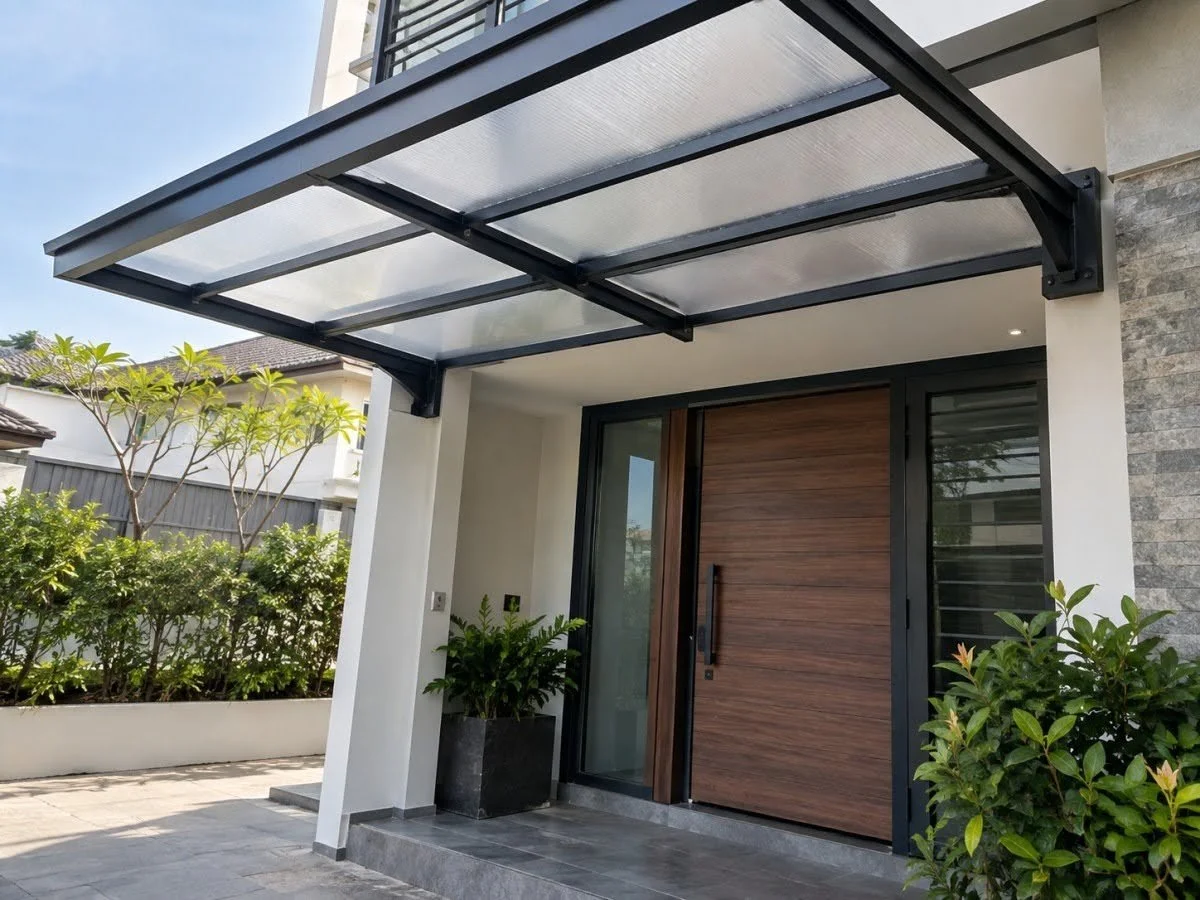
An entrance is a natural location for an overhead canopy because people regularly move between indoor and outdoor environments.
The required coverage should be based on the transition area rather than simply matching the width of the door.
Projection also matters. An awning with limited projection may cover the doorway itself without providing meaningful shelter immediately outside it.
At the same time, the design should remain proportionate to the façade and consider nearby windows, lighting, and architectural features.
Polycarbonate Canopies Can Work Along Walkways
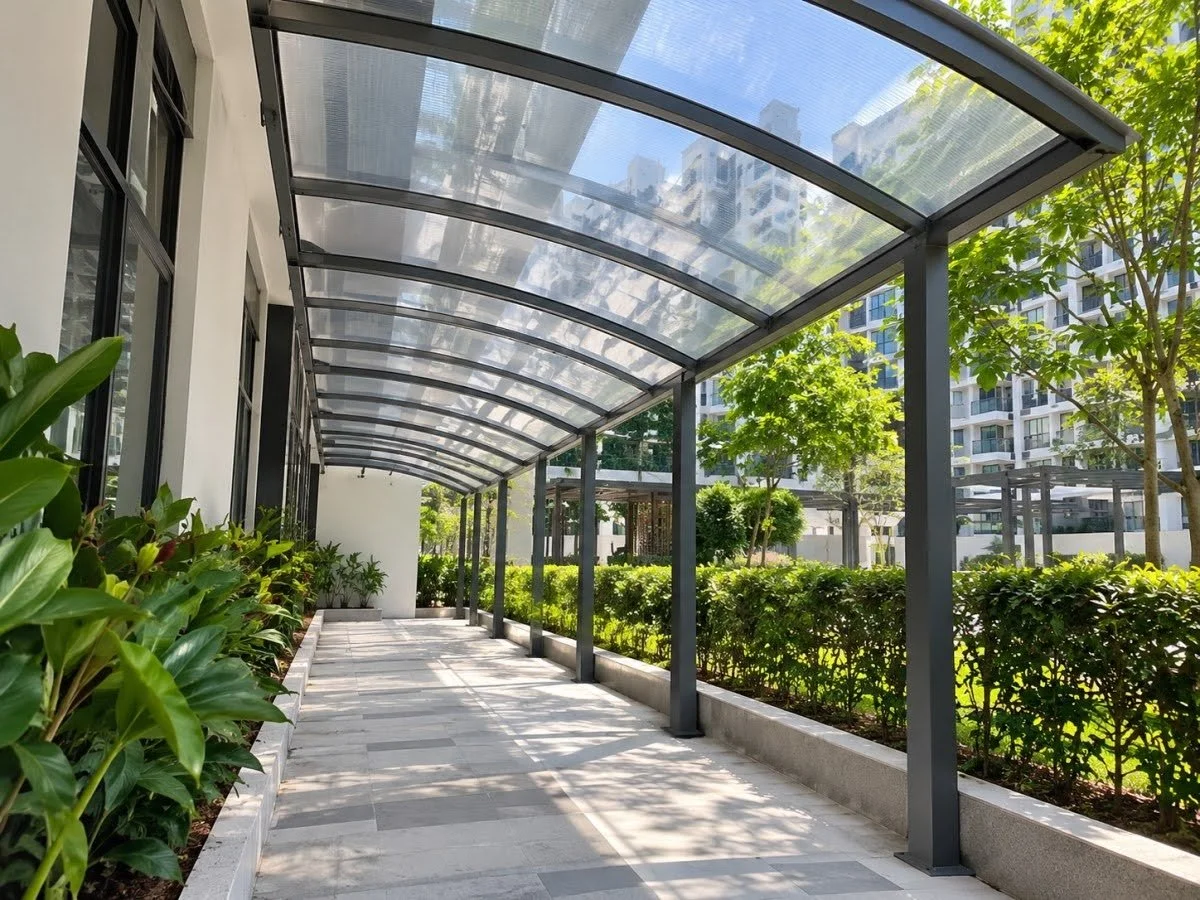
A polycarbonate canopy in Singapore can be considered for walkways where overhead shelter and continued daylight are both useful.
Longer walkway applications require planning beyond repeating a small entrance canopy multiple times.
The complete route should be assessed for width, alignment, changes in direction, and nearby property features.
Pedestrian movement should also remain practical beneath the finished shelter.
Where a walkway passes alongside windows or other openings, the ability of polycarbonate to transmit light can be particularly relevant to the overall design.
Residential Outdoor Areas Need Application-Specific Planning
Residential properties can contain many different exterior spaces, so the term “residential awning” does not describe one standard configuration.
A shelter near an entrance may need to be compact and visually integrated with the façade. A longer side passage may require continuous coverage. Another area may need a broader canopy.
Property owners should identify which activities or movements need protection before determining dimensions.
This prevents the project from becoming a general attempt to cover as much outdoor space as possible without a defined purpose.
Commercial Properties Should Consider Pedestrian Movement
Commercial polycarbonate awnings can be used where outdoor coverage needs to coexist with entrances, customer routes, or other operational areas.
The design should account for how people move beneath and around the shelter.
Supporting elements should not unnecessarily restrict important circulation areas, while the canopy dimensions should correspond with the zone that actually requires coverage.
Signage, exterior lighting, and other façade features can also influence the available installation area.
A commercial canopy should therefore be evaluated as part of the building's operational environment.
Polycarbonate Awning and Polycarbonate Canopy Can Describe Similar Applications
The functions of a “polycarbonate awning” and “polycarbonate canopy” can overlap in everyday property discussions. Both can refer to overhead shelter systems using polycarbonate sheets.
The terminology alone does not determine the design.
A smaller shelter projecting from a building may commonly be described as an awning, while a larger covered entrance or walkway may be described as a canopy.
For property owners, the more important questions concern the required dimensions, support, coverage, and site conditions rather than the label applied to the structure.
Light Transmission Varies Between Products
Polycarbonate is not one visually identical product. Different sheet types, colours, finishes, and specifications can affect how much light passes through the covering and how the shelter appears.
Property owners should therefore avoid assuming that every polycarbonate awning will create the same lighting conditions.
If light transmission is an important selection criterion, information for the specific proposed sheet should be reviewed.
Samples or completed project examples can also help illustrate appearance, although actual site conditions will influence how the installed canopy is perceived.
Sunlight and Heat Should Be Evaluated Separately
Natural light, solar exposure, and heat are related but should not be treated as identical considerations.
A translucent or transparent covering may allow daylight into the area while also being exposed to direct sunlight. The resulting conditions depend on the specific product, property orientation, and surrounding environment.
Property owners concerned about heat should therefore avoid relying only on general descriptions of polycarbonate.
Relevant performance information should be checked against the actual sheet specification being proposed.
Site conditions should also be considered because the same material can experience different levels of direct sunlight in different locations.
UV-Related Claims Should Be Product-Specific
Polycarbonate products may have different specifications relating to ultraviolet exposure or protection.
A property owner should not assume that every sheet provides identical UV characteristics simply because it is made from polycarbonate.
Where UV performance is important, the installer should identify the specific product and the relevant manufacturer information.
This product-specific approach keeps the decision factual and avoids broad performance claims that may not apply equally to every polycarbonate sheet.
Rain Protection Depends on the Complete Canopy Design
A polycarbonate sheet can form the overhead surface of a shelter, but effective rain coverage depends on more than the material.
The canopy dimensions, projection, slope, open sides and relationship with the building all influence how much protection the area receives.
Wind-driven rain can also enter from exposed sides.
For this reason, a polycarbonate awning should not automatically be treated as creating a completely dry enclosure.
The required level of rain protection should be discussed according to how the covered space will actually be used.
Projection Determines How Far the Shelter Extends
Projection is the distance the awning extends outward from its mounting area. It has a direct effect on the physical zone covered beneath the canopy.
Too little projection may not provide the intended shelter. Excessive projection may be unnecessary or unsuitable for the available site.
The correct dimension should therefore be based on the coverage requirement and property conditions.
Entrances, walkways and other applications can require different projections even when the same type of polycarbonate sheet is used.
Open Sides Affect Weather Protection
An awning primarily provides overhead coverage. Unless the design includes additional elements, the sides remain open.
This matters in Singapore because rainfall can approach outdoor areas at an angle rather than only from directly overhead.
A wider canopy may increase the protected zone, but site exposure still needs to be considered.
Property owners should have realistic expectations about the difference between an overhead awning and a fully enclosed outdoor area.
Drainage Is Part of the Canopy Design
Rainwater landing on a polycarbonate awning needs to move away from the covered area appropriately.
The exact drainage arrangement depends on the canopy design and property.
The location of entrances, pedestrian routes and existing drainage points can influence how water should be managed.
Drainage planning becomes particularly important for larger canopy areas because more surface area can collect more rainfall.
The intended water path should therefore be considered during design rather than after installation.
Sheet Layout Can Affect the Appearance of the Canopy
A polycarbonate canopy should be viewed as a complete architectural surface rather than only as individual sheets.
On larger installations, the layout of the sheets and supporting components can become visually prominent.
The design should consider how the sections align with the property and with each other.
Where the canopy is highly visible from the exterior, a deliberate layout can help it integrate more naturally with the surrounding architecture.
Supporting Components Are Part of the Overall Design
The transparent or translucent covering may attract most of the attention, but the supporting system also contributes to the appearance and function of a polycarbonate awning.
Its configuration depends on the dimensions, canopy design and installation conditions.
Supporting elements should be considered during planning because they remain visible in many applications.
A polycarbonate awning installer in Singapore should therefore be able to explain the complete proposed system rather than discussing only the sheet material.
Installation Requires Confirmed Site Measurements
Polycarbonate awnings should be based on actual site measurements, particularly where the shelter needs to align with doors, windows, walkways, or other property features.
The contractor may need to establish width, projection, mounting position, and relevant clearances.
Approximate dimensions can support an early discussion but should not replace project measurements where components are being prepared for the site.
Accurate information helps ensure that the completed canopy corresponds with the intended coverage area.
Existing Doors and Windows Should Remain Functional
A new canopy should not unnecessarily interfere with the normal use of the property.
Windows and doors near the installation area should be identified during site assessment.
Their position can influence canopy height, projection and supporting arrangements.
Natural light entering nearby windows may also be part of the reason for considering polycarbonate in the first place.
Reviewing these features before finalising the design can prevent conflicts that become difficult to resolve during installation.
Maintenance Should Preserve Light and Visibility
Because light transmission is often an important reason for choosing polycarbonate, accumulated dirt can affect the appearance and experience of the canopy.
Cleaning should follow guidance appropriate to the specific sheet product.
Property owners should avoid assuming that every cleaning chemical or abrasive method is suitable for polycarbonate surfaces.
Reasonable access for future cleaning should also be considered during planning, particularly for larger or higher canopies.
Debris Should Not Be Allowed to Accumulate Unnecessarily
Outdoor canopies can collect leaves and environmental debris depending on their location.
Accumulation may affect appearance and can interfere with areas involved in water movement.
The frequency of inspection depends on the surrounding environment. A canopy beneath nearby trees may require different attention from one in a more open location.
Routine observation can help property owners identify when cleaning or further assessment is appropriate without creating an unnecessarily complicated maintenance schedule.
A Polycarbonate Awning May Not Suit Every Property
Polycarbonate is not automatically the right choice whenever an outdoor shelter is required.
A property owner who specifically wants a completely opaque overhead surface may prefer another system. Someone who needs adjustable coverage rather than a permanent canopy may be better served by a retractable solution.
The site itself can also introduce constraints affecting the feasibility of a proposed canopy.
The appropriate choice therefore depends on the functional requirement rather than the popularity of the material.
Actual Projects Can Demonstrate Different Applications
Completed polycarbonate awning projects can help property owners understand how the material is used across different types of spaces.
Useful project examples show more than the sheet itself. They demonstrate overall dimensions, supporting arrangements, façade integration and the amount of coverage created.
Moonlight Pte Ltd's actual project examples can provide practical context for how polycarbonate awnings and canopies are incorporated into different properties.
Examples similar to the proposed application are generally more informative than unrelated installations.
Questions to Ask Before Choosing Polycarbonate
Property owners can evaluate suitability by focusing on a small number of project-specific questions:
Does the area require permanent overhead shelter?
Is natural light through the covering important?
How much of the space needs to be covered?
How exposed is the location to sunlight and rain?
Where should collected rainwater be directed?
Are nearby windows, doors or walkways affected?
What specific polycarbonate sheet is being proposed?
These questions connect material selection with actual property requirements.
Frequently Asked Questions (FAQs)
What is a polycarbonate awning?
A polycarbonate awning is a fixed overhead shelter that uses polycarbonate sheets as the covering. It can provide rain and sun shelter while allowing a degree of natural light through the material, depending on the specific sheet used.
What is the difference between a polycarbonate awning and canopy?
The terms can overlap. “Awning” often describes a shelter projecting from a building, while “canopy” can describe a broader entrance, walkway, or outdoor coverage. The actual design and dimensions are more important than the terminology.
Does a polycarbonate awning block all sunlight?
Not necessarily. Polycarbonate sheets can transmit light, with the amount depending on the specific product. Property owners should review the proposed sheet specifications where light transmission is important.
Can polycarbonate awnings protect against rain?
They can provide overhead rain protection, but the level of shelter depends on dimensions, projection, open sides and site exposure. Wind-driven rain may still reach areas beneath an open-sided canopy.
How do I choose a polycarbonate awning installer in Singapore?
Look for an installer who assesses the actual site, explains the proposed sheet and supporting system, takes appropriate measurements and can show relevant project applications. Recommendations should be connected to the property's requirements.
Use Polycarbonate Where Light Is Part of the Requirement
A polycarbonate awning is most relevant where a property needs fixed overhead shelter while retaining a degree of natural light through the covering.
The decision should still account for the specific outdoor area, canopy dimensions, sunlight exposure, rainfall, drainage, and surrounding architectural features.
By treating light transmission as one part of a complete canopy design rather than the only reason to choose the material, property owners can determine more clearly whether polycarbonate suits the intended application.
Assess a Polycarbonate Awning for Your Property
Property owners considering a polycarbonate awning can gather information about the area needing coverage, the importance of natural light, and nearby doors, windows, or drainage points before arranging an assessment.
For project-specific guidance on polycarbonate awning and canopy applications, contact Moonlight Pte Ltd to discuss the proposed property requirements.