Retractable Awnings in Singapore: When Are They the Right Choice?
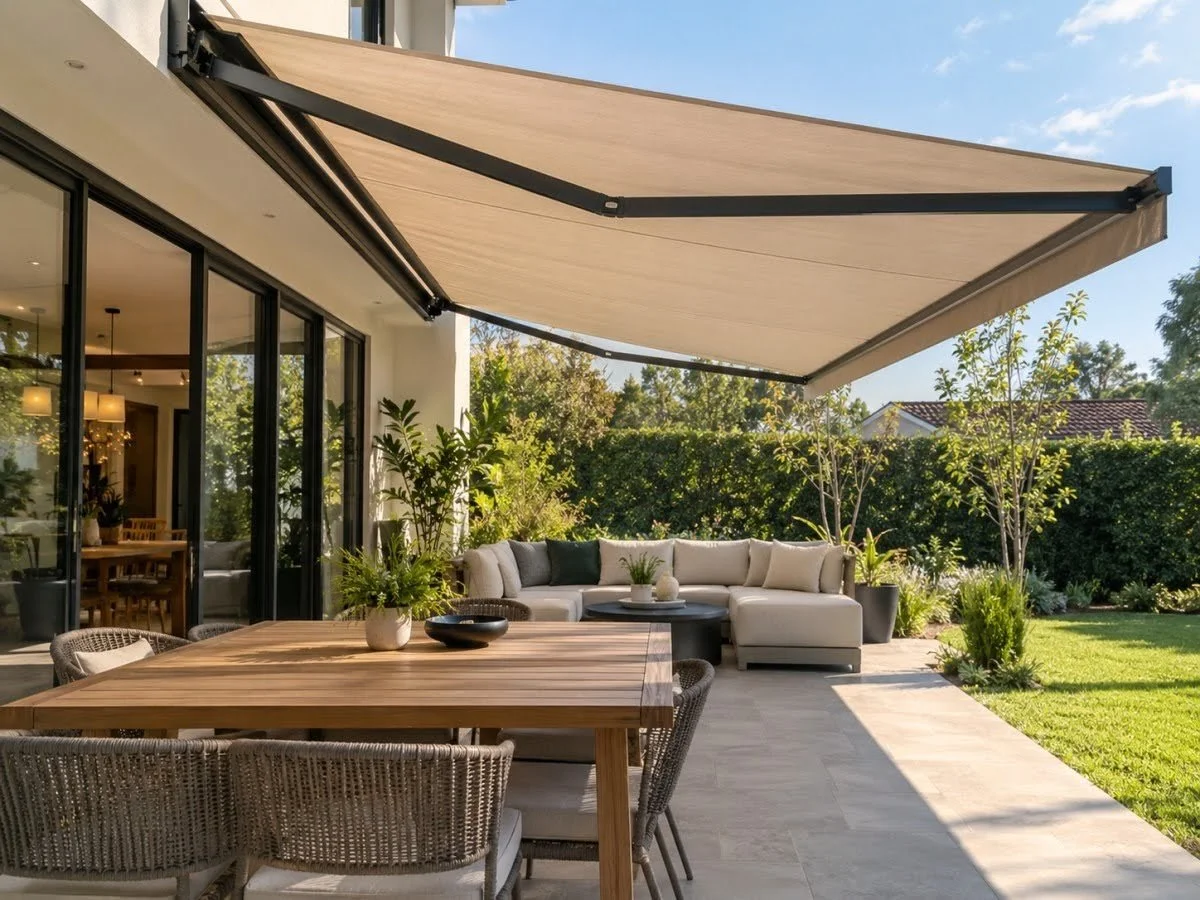
A retractable awning is an adjustable outdoor shelter that can be extended when shade or coverage is wanted and retracted when the area is preferred open. For property owners considering a retractable awning in Singapore, the main reason to choose this system is flexibility rather than permanent shelter.
This makes retractable awnings different from fixed canopies. A patio, balcony-facing outdoor area, commercial frontage, or other usable exterior space may benefit from shade during particular periods without requiring a permanent overhead covering throughout the day.
The right choice depends on how frequently the outdoor area is used, when shade is required, whether an open overhead environment is desirable at other times and whether the property can accommodate the operating system.
Retractable Awnings Are Designed for Adjustable Coverage
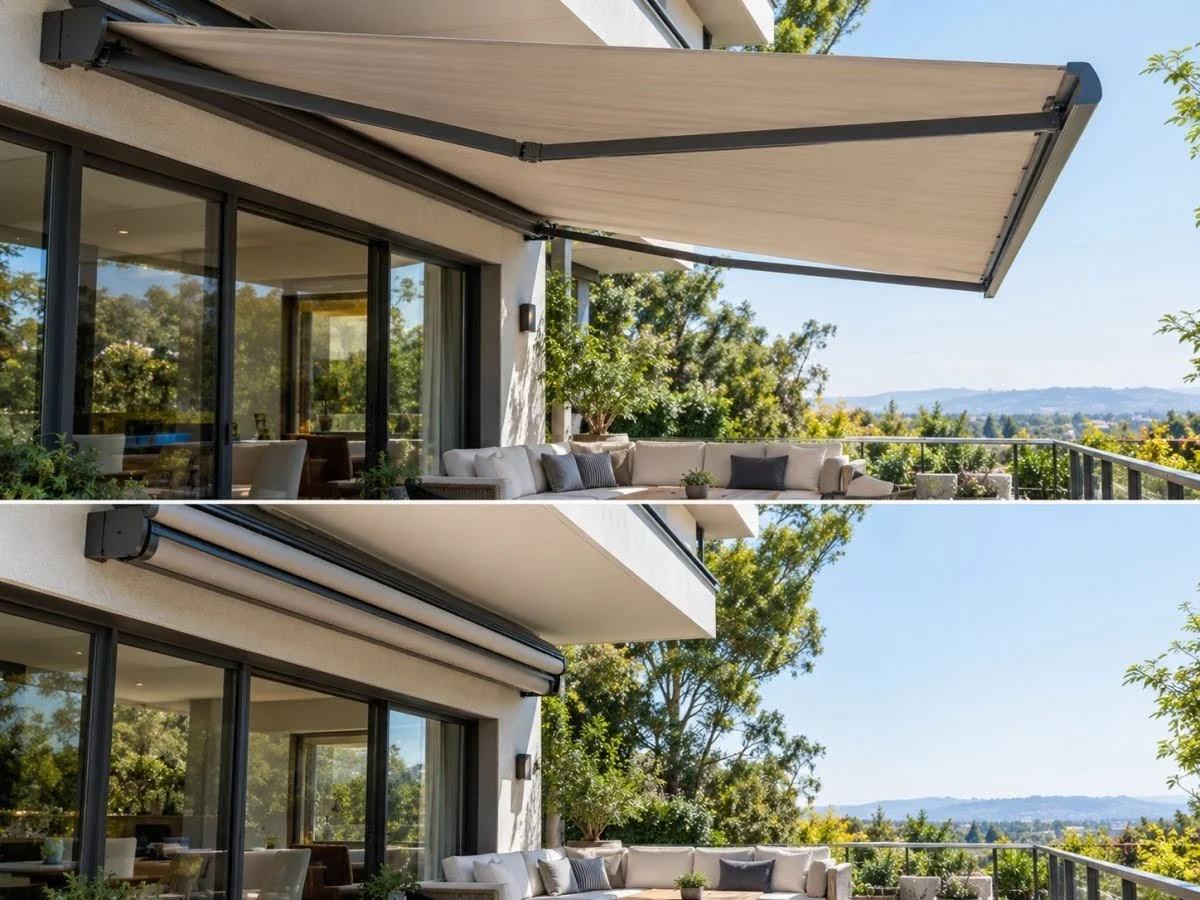
A retractable awning changes the amount of overhead coverage available to an outdoor space.
When extended, it creates a covered area beneath the awning. When retracted, the covering returns towards its stored position and leaves more of the space open overhead.
This adjustability is the defining characteristic of the system.
Property owners should therefore consider a retractable awning when the need for shade changes rather than when permanent coverage is required at all times.
Start by Asking Whether the Space Needs to Remain Open Sometimes
The clearest way to determine whether a retractable system is relevant is to ask whether there are times when no overhead covering is preferred.
If the answer is yes, adjustable shelter may provide a practical advantage.
A property owner may want shade during stronger sunlight but prefer an open outdoor area during other periods. A commercial space may use shade during operating hours without wanting a permanent canopy to dominate the frontage.
Where the area should remain covered continuously, a fixed awning may deserve stronger consideration instead.
Retractable Systems Extend Outward from a Stored Position
A retractable awning normally operates by extending its covering outward from the mounting area and returning it when coverage is no longer required.
The exact mechanism depends on the particular system.
Because the awning moves, the area through which it operates needs to be considered during planning. Nearby structures and other property features should not unnecessarily interfere with its intended movement.
The operating range is therefore an important part of site assessment rather than a detail to consider only after installation.
Adjustable Shade Is Different from Permanent Shelter
A retractable awning is particularly useful when shade is a changing requirement.
The outdoor area may receive stronger direct sunlight during one part of the day and less during another. Extending the awning when additional shade is useful allows the property owner to respond to those changing conditions.
Retracting it later can restore a more open environment.
This flexibility distinguishes the system from a fixed awning, which remains in position regardless of changing sunlight or how the space is being used.
Patios Can Benefit from Flexible Overhead Shade
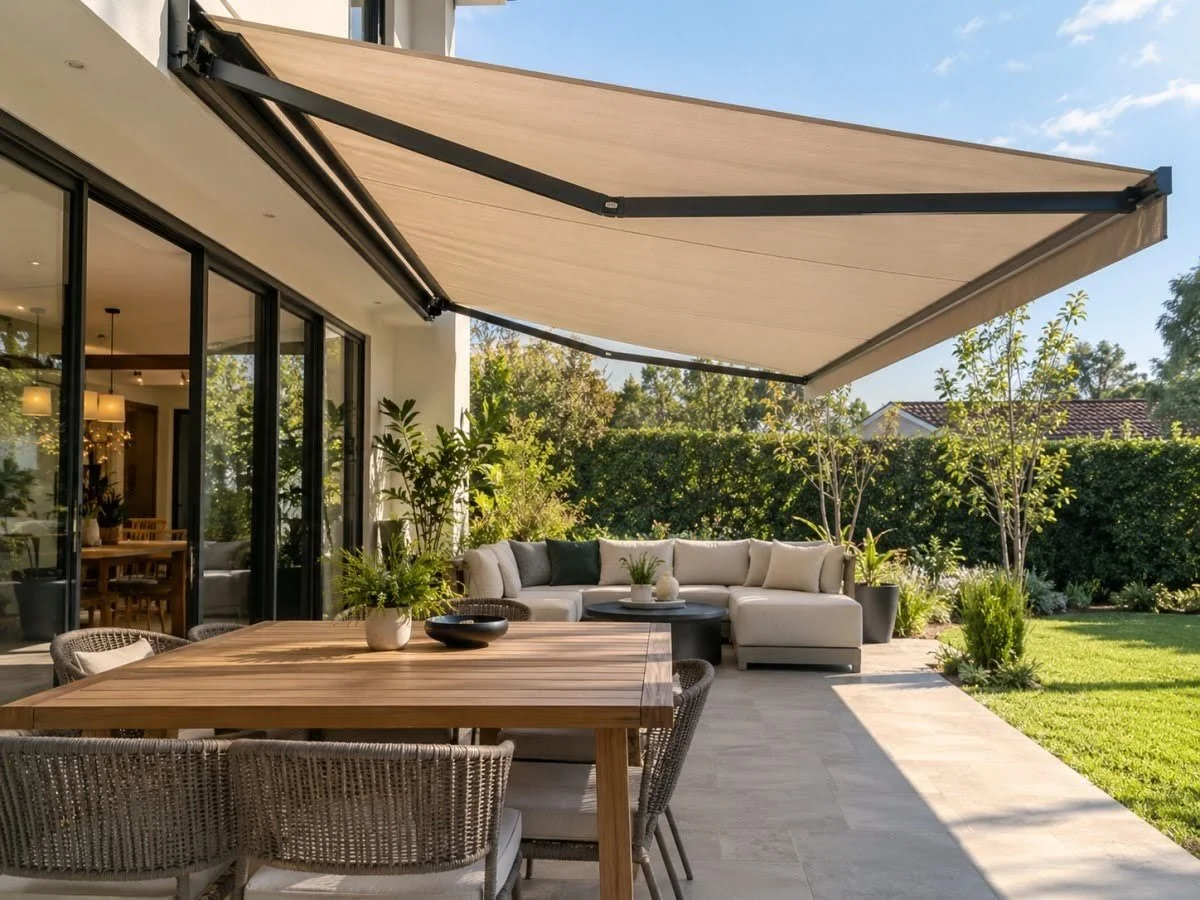
Residential patios are one application where adjustable coverage can be useful because their use may vary throughout the day.
A patio might be used for sitting, dining, or other activities during particular periods. At other times, occupants may prefer the area without an overhead covering.
A retractable awning allows these two conditions to exist within the same space.
The required dimensions should be based on the part of the patio that actually needs adjustable shade rather than automatically covering the entire outdoor area.
Outdoor Living Areas Should Be Planned Around Activity Zones
A larger outdoor area may contain different activity zones rather than functioning as one uniform space.
Seating could occupy one section while circulation or landscaping occupies another. Only part of the area may require adjustable shade.
Identifying the main activity zone helps determine the appropriate awning width and projection.
This can produce a more purposeful installation than extending the awning across areas where overhead coverage provides little practical benefit.
Residential Applications Should Consider Nearby Openings
Doors and windows close to a retractable awning can influence its positioning.
The awning should fit the façade without unnecessarily affecting the normal operation of these openings.
Property owners should also consider how the extended awning changes daylight around nearby windows.
When retracted, the conditions may be different again.
This changing relationship between the awning and the property is one reason retractable systems should be assessed in both their extended and stored positions.
Commercial Awnings Can Adapt to Changing Use
Commercial outdoor spaces can have different requirements at different times.
A retractable awning may be relevant where an area benefits from shade during customer or operational use but does not require permanent coverage.
The design should still consider pedestrian movement, entrances, signage and the appearance of the commercial frontage.
Because the system changes position, both operating states should be reviewed.
An awning that fits the property when retracted should also function appropriately when fully extended.
Sun Direction Helps Determine When the Awning Will Be Useful
The usefulness of adjustable shade depends partly on when sunlight reaches the area.
A property may experience direct sunlight in the morning, afternoon or during a narrower period depending on orientation and surrounding buildings.
Observing these conditions can help property owners understand how frequently the awning is likely to be extended.
If the space remains naturally shaded for much of the day, the need for an additional retractable system may be different from a highly exposed location.
Projection Determines the Adjustable Shade Area
Projection refers to how far the awning extends outward when open.
This dimension helps determine the area that can receive overhead shade.
A greater projection is not automatically more suitable. The awning should correspond with the usable outdoor area and available installation conditions.
Furniture placement, pedestrian movement and the shape of the outdoor space can all influence the appropriate projection.
The objective is to cover the intended activity zone rather than simply maximise the size of the awning.
Width Should Correspond with the Main Use Area
The width of a retractable awning determines how much of the façade or outdoor space it spans.
For a residential patio, this may correspond with a seating or dining area. For a commercial property, it may relate to a defined customer-facing zone.
The width should also make sense visually when compared with nearby doors, windows and other architectural features.
A site-specific measurement is therefore more useful than selecting an awning solely from standard dimensions.
Manual Retractable Awnings Provide Direct Operation
A manual retractable awning is operated physically by the user through the mechanism provided with the system.
This approach can suit properties where adjustment is relatively straightforward and the awning does not need to be repositioned frequently.
Manual operation avoids relying on motorised controls for normal extension and retraction.
However, the operating point should be practical to access.
Property owners should consider who will regularly use the awning and how often adjustments are expected before choosing manual operation.
Automatic Awnings Add Motorised Operation
An automatic awning in Singapore generally uses a motorised system to extend or retract the covering through supported controls.
This can make frequent adjustment more convenient, particularly where users want to reposition the awning without manual operation.
The exact controls and functions depend on the specific system installed.
Property owners should confirm what is actually included rather than assuming that every automatic awning has the same features or level of automation.
The primary distinction is that the awning movement is motor-driven rather than manually operated.
Manual or Automatic Should Be a Usage Decision
The choice between manual and automatic operation should reflect how the awning will be used rather than being treated simply as an upgrade decision.
A manual system may be sufficient where adjustment is occasional and the operating point is easily accessible.
Motorised operation may be more practical where the awning is expected to be adjusted regularly or where easier operation is an important requirement.
The appropriate option depends on the users, property and expected frequency of adjustment.
Controls Should Be Easy for the Intended Users to Understand
Where an automatic awning is installed, users should understand how to extend, retract and stop the system using the supported controls.
The control method depends on the specific product.
Property owners should ask what controls are included and where they will be positioned or stored.
Clear operating guidance is important because motorisation should simplify normal use rather than introduce uncertainty about how the awning is meant to function.
Singapore Weather Requires Active User Awareness
Retractable awnings are adjustable systems, so property owners should understand that their position may need to change according to weather and operating guidance.
The appropriate use of a retractable awning during rain, wind or other weather conditions depends on the specifications and instructions for the actual system.
Property owners should not assume that every retractable awning can remain extended in all weather.
The installer should explain relevant operating limitations based on the selected product.
Rain Protection Should Not Be Assumed to Be the Primary Function
A retractable awning may provide some overhead coverage when extended, but property owners should not automatically treat it as equivalent to a permanent fixed roof.
The intended use of the specific awning system should be confirmed.
If continuous rain shelter is the main requirement, a fixed solution may deserve consideration because it remains in position without depending on user operation.
Retractable systems are most clearly differentiated by adjustable shade and flexible coverage.
Wind Exposure Should Be Discussed Before Installation
Outdoor awnings are exposed to local conditions that vary by property.
An open or elevated location may experience different wind exposure from a more sheltered area.
Where this is relevant, the property owner should discuss site conditions and operating guidance with the installer.
Any wind-related limitations should be based on the actual awning system rather than a general assumption that applies to every retractable product.
This information helps users understand when the awning should or should not remain extended.
A Retractable Awning Needs Space to Operate
Because the awning changes position, its operating path needs to remain clear.
Exterior lighting, signs, architectural features and other structures can potentially affect the available space.
The installer should assess the awning in its fully extended configuration rather than considering only the compact stored position.
The area beneath the awning should also remain suitable for its intended use when the system is open.
The Stored Position Matters to the Façade
A retractable awning remains visible to some degree even when it is not extended, depending on the particular design.
Its stored position should therefore be considered in relation to the property façade.
The awning should fit around windows, doors, signage and other exterior features.
For commercial properties, this can be particularly important where the frontage forms part of the customer-facing appearance of the business.
Both the extended and retracted views should be considered during planning.
Installation Requires Accurate Width and Projection Measurements
Retractable systems need confirmed site dimensions before installation.
The installer should determine the appropriate width, projection, mounting location and relevant clearances.
These measurements help establish whether the selected awning configuration fits the available space and covers the intended area when extended.
They also help identify nearby property features that could interfere with normal operation.
Approximate measurements can support early discussions, but the final installation should rely on site-specific information.
Motorised Systems Introduce Additional Installation Considerations
An automatic awning includes motorised components, which means installation involves considerations beyond the physical covering.
The exact requirements depend on the system selected.
Property owners should understand what is required for the proposed motorised operation and whether any related preparation is needed at the property.
These requirements should be clarified before installation rather than assumed.
Only functions actually supported by the selected system should be included in project expectations.
Operation Should Be Tested During Handover
A retractable awning should be tested after installation to confirm normal extension and retraction.
Manual systems should be demonstrated so that users understand the intended operating method.
For automatic systems, the relevant controls should also be demonstrated.
The property owner should know how to stop and reposition the awning using the functions provided.
Handover is therefore an important part of the installation because the user interacts directly with the system after the contractor leaves.
Maintenance Includes Attention to Moving Components
Retractable awnings contain moving parts, which distinguishes their maintenance needs from purely fixed shelters.
Property owners should observe whether the awning continues to extend and retract normally during regular use.
Visible debris should not be allowed to interfere unnecessarily with the system.
Cleaning and maintenance methods should follow guidance for the installed product.
If movement becomes unusual, repeatedly forcing the awning may be less appropriate than arranging further assessment.
The Awning Covering Also Requires Appropriate Care
The retractable covering remains part of an outdoor system and should be maintained according to the relevant product instructions.
The appropriate cleaning method depends on the material used in the installed awning.
Property owners should avoid assuming that strong cleaning agents or abrasive methods are suitable.
The objective is to preserve normal appearance and function without introducing unnecessary wear through inappropriate maintenance.
When a Fixed Awning May Be More Appropriate
A retractable awning is not automatically the better option simply because it can move.
A fixed awning may be more appropriate where permanent overhead coverage is required throughout normal use.
Examples can include areas where the main objective is consistent shelter rather than adjustable shade.
A fixed solution can also make more sense where users do not expect to change the amount of coverage.
The choice should therefore reflect the function of the outdoor space rather than the perceived sophistication of the system.
A Simple Decision Framework for Retractable Awnings
Property owners can assess whether retractable coverage suits their needs by asking:
Do I want the area open overhead at certain times?
Is adjustable shade important to how the space is used?
Which part of the outdoor area actually needs coverage?
How frequently will the awning be extended or retracted?
Is manual or motorised operation more practical for the users?
Can the property accommodate the awning in both positions?
Do I understand the operating limitations of the proposed system?
If permanent coverage is the priority, another awning type may be more suitable.
Frequently Asked Questions (FAQs)
What is a retractable awning?
A retractable awning is an adjustable shelter that can be extended to provide overhead coverage and retracted when the user prefers the area to remain more open. It can be manually operated or motorised depending on the system.
Where can retractable awnings be used?
They can be considered for residential patios, outdoor living areas and selected commercial spaces where adjustable coverage is useful. Suitability depends on the site, required dimensions and how the area is used.
What is the difference between manual and automatic awnings?
A manual awning requires physical user operation, while an automatic awning uses a motorised mechanism and supported controls. The appropriate choice depends on expected usage and convenience requirements.
Can a retractable awning be used during rain?
The appropriate weather use depends on the specifications and operating guidance of the particular awning system. Property owners should confirm these limitations with the installer rather than assuming that every retractable awning is intended for the same conditions.
When is a fixed awning better than a retractable awning?
A fixed awning may be more suitable where continuous overhead shelter is required and there is little reason to open the area above. Retractable systems are more relevant where adjustable coverage provides a practical benefit.
Flexibility Should Solve a Real Need
A retractable awning makes the most sense when the outdoor space genuinely benefits from changing between covered and open conditions.
Property owners should therefore focus on when the area needs shade, how frequently the awning will be adjusted and whether manual or automatic operation suits the intended users.
Site dimensions, sunlight exposure, operating space and weather guidance should then be evaluated around that requirement.
When flexibility serves a clear purpose, a retractable system can become a practical part of how the outdoor space is used rather than simply an alternative to a fixed awning.
Consider Adjustable Shade for Your Outdoor Space
Property owners considering a retractable awning can identify when the outdoor area needs shade, the zone requiring coverage, and how frequently adjustment is expected before arranging an assessment.
For project-specific guidance on retractable and automatic awning applications, contact Moonlight Pte Ltd to discuss the proposed outdoor space.